



Why Digital Twins require structure before technology
Territories do not begin as systems. They emerge from geography, resources, and human settlement responding to opportunity rather than design, and only later do institutions, infrastructures, and regulations attempt to impose order. What we call “territory” is therefore the result of accumulated decisions, overlapping responsibilities, and partial representations that rarely align into a single coherent view.
As territories grow, complexity increases faster than governance structures can adapt. New infrastructures are built, services expand, and regulations multiply, but each responds to a specific need, sector, or moment in time. Over decades, this produces a landscape where the same physical space is governed, modeled, and interpreted through disconnected lenses that never fully converge.
This is why many digital initiatives struggle from the start. They attempt to digitize fragments of territory without first understanding how those fragments relate to one another. Models become more detailed, data more abundant, and tools more sophisticated, yet decisions remain siloed because the underlying system was never defined.
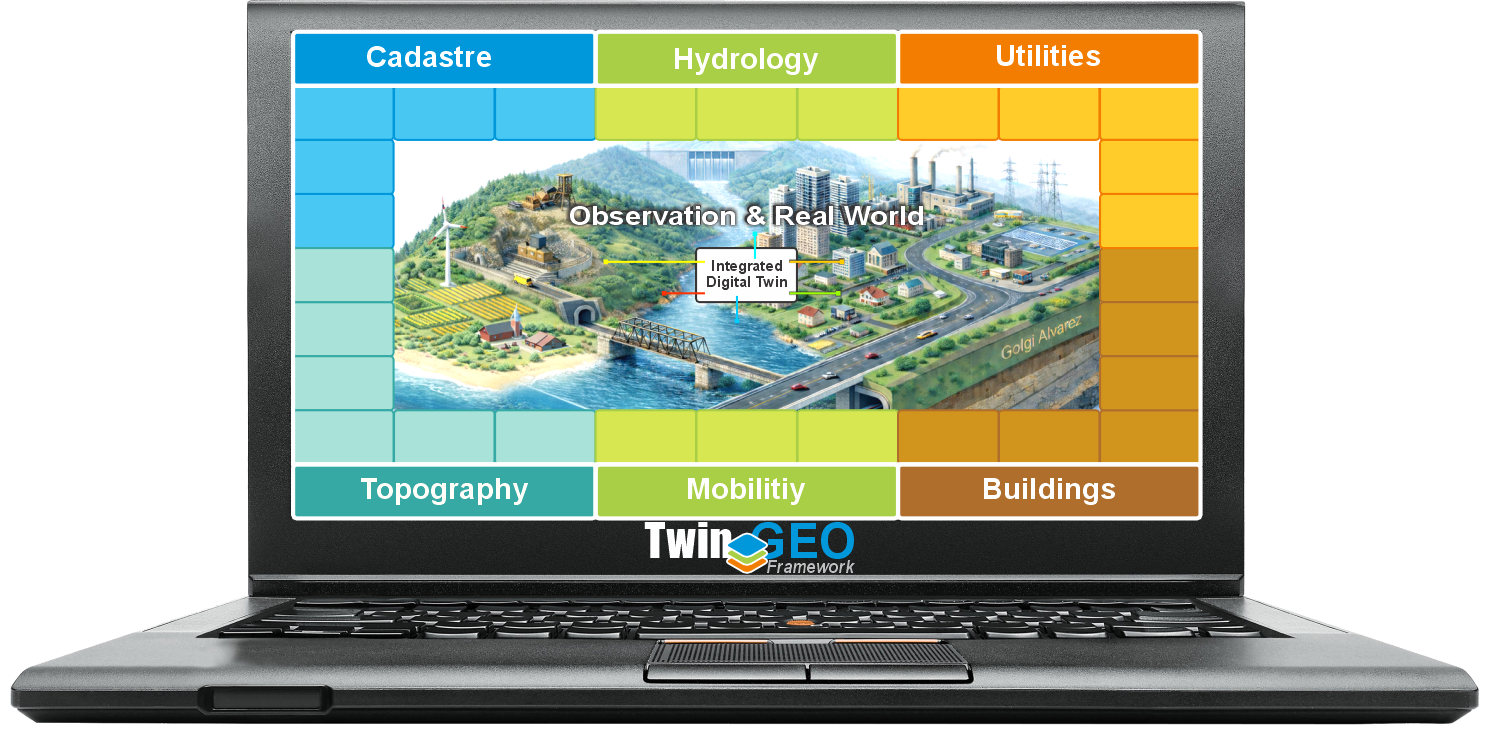
A territory becomes a system only when its components are understood in relation to one another. Domains must be recognized as coexisting within the same space, assets must persist beyond individual projects, processes must reflect institutional reality, and feedback from the real world must continuously inform digital representations. Without this systemic view, digital twins remain isolated models rather than operational instruments.
Systems thinking does not simplify territory; it makes its complexity manageable. By introducing structure before technology, it becomes possible to align disciplines, reduce fragmentation, and ensure that digital representations evolve alongside governance and reality. This is the point where digital initiatives stop producing outputs and begin supporting decisions.
TwinGEO was conceived from this understanding. It does not propose technology as a starting point, but structure as a prerequisite. Only when territory is treated as an integrated, evolving system can digital twins emerge as decision-ready infrastructures rather than static visualizations.
Understanding how territories become systems is the first step toward building digital twins that actually work.
→ Explore the TwinGEO Layers
→ Explore the Integrated Framework