



Utilities Domain
Service Networks and Operational Infrastructure
Utilities represent the infrastructure systems that provide essential services required for daily life, economic activity, and urban functioning.
Utilities assets are managed as interconnected service networks, supporting reliable and continuous service delivery across the territory. These networks operate as critical lifelines, where performance, resilience, and coordination are fundamental.
Within the TwinGEO Framework, utilities are understood as operational network systems, not isolated facilities.
Core Components of the Utilities Domain
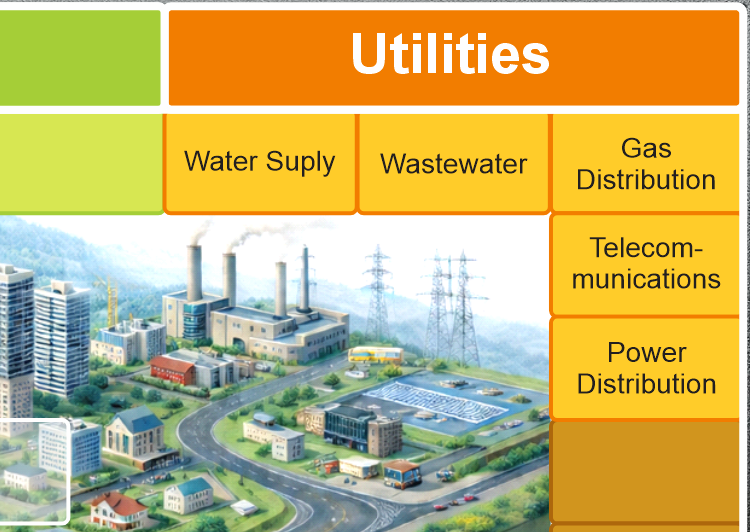
The utilities domain integrates the main service infrastructure systems, including:
- Water supply systems management
Production, storage, distribution, and quality control of potable water. - Wastewater infrastructure systems
Collection, conveyance, treatment, and discharge of wastewater and sanitation services. - Power distribution networks
Electrical generation interfaces, substations, and distribution networks. - Gas distribution systems
Transport and delivery of gas through regulated pipeline networks. - Telecommunication infrastructure systems
Physical and logical networks enabling communication and data exchange. - Integrated utility systems Digital Twins
Coordinated representations of multiple service networks supporting analysis and operation.
Together, these components sustain continuous service provision and territorial functionality.
Utilities as a Cross-Domain Backbone
Utilities interact deeply with other territorial domains:
- Buildings, through service demand, connection, and operation
- Mobility, through corridor sharing and infrastructure coordination
- Governance, through easements, rights-of-way, and regulation
- Hydrology and topography, through routing, protection, and risk management
Managing utilities in isolation increases vulnerability and inefficiency.
TwinGEO treats utilities as a backbone of territorial systems, requiring integrated management.
From Utility Networks to Digital Twins
Traditional utility models often focus on individual networks or assets.
Within TwinGEO, utilities become part of an operational Digital Twin when:
- networks are modeled as connected systems
- service performance and reliability are monitored
- failures and scenarios are evaluated across domains
- operational decisions are supported in near real-time
This enables decisions related to:
- maintenance and asset renewal
- service continuity and resilience
- network expansion and coordination
- risk management and emergency response
Utilities and Decision-Making
Utilities answer a critical territorial question:
How are essential services delivered reliably and continuously across the territory?
By integrating utilities into Digital Twin Systems, TwinGEO supports coordinated, resilient, and sustainable service delivery.
Domains as Systems, Not Categories
TwinGEO domains are not software groupings or discipline-based silos.
They are real-world system families that structure Digital Twin development across disciplines, lifecycles, and decision contexts.
Each domain contributes essential assets, processes, and observation pathways toward integrated territorial Digital Twin Systems.