




Buildings Domain
Built Environment and Operational Assets
Buildings represent the built environment as a system of long-lived, heterogeneous assets supporting habitation, production, and services.
Building assets are managed as a portfolio of heterogeneous assets, governed by construction, operation, safety, and sustainability processes. Unlike linear infrastructure, buildings combine structural, spatial, technical, and operational dimensions within a single asset class.
Within the TwinGEO Framework, buildings are treated as operational systems, not just design objects.
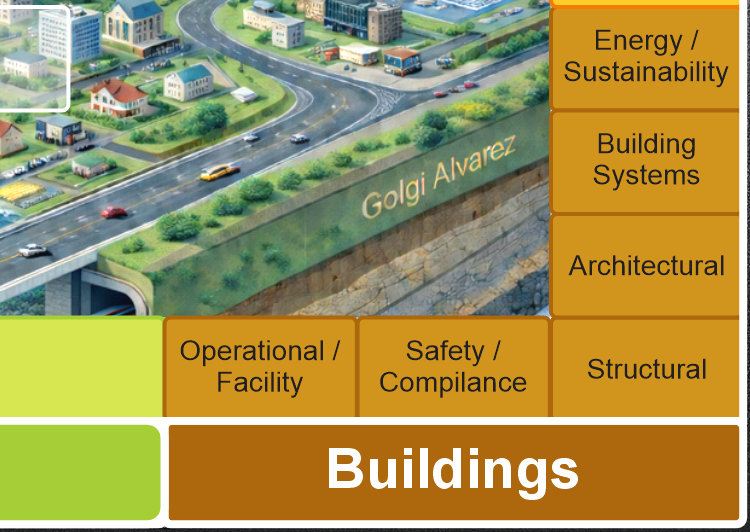
Core Components of the Buildings Domain
The buildings domain integrates the key systems that define the built environment, including:
- Structural systems for buildings
Load-bearing structures, foundations, and construction systems ensuring stability and safety. - Architectural systems and spatial design
Functional layouts, spatial organization, and user-oriented design. - Building systems and services
Mechanical, electrical, plumbing, vertical transport, and technical installations. - Energy and sustainability in buildings
Energy performance, efficiency, emissions, and environmental impact. - Safety, compliance, and building regulation
Codes, standards, inspections, and regulatory enforcement. - Building operations and facility management
Operation, maintenance, performance monitoring, and lifecycle optimization. - Building Digital Twin foundations
Integrated representations supporting analysis, operation, and decision-making.
Together, these components reflect the full lifecycle of buildings, from design to operation.
Buildings as a Cross-Domain Asset Class
Buildings interact directly with multiple domains:
- Governance, through property units, rights, and development permissions
- Mobility, through access, connectivity, and urban form
- Utilities, through service supply and demand
- Topography and hydrology, through site conditions, risk, and resilience
Ignoring these interactions leads to building models that perform well individually but fail at the territorial scale.
TwinGEO frames buildings as embedded territorial assets, not isolated projects.
From Building Models to Building Digital Twins
Traditional building models often stop at design or construction.
Within TwinGEO, buildings become part of an operational Digital Twin when:
- building systems are linked to lifecycle processes
- operational data informs performance and maintenance
- regulatory compliance is traceable over time
- sustainability objectives are continuously evaluated
This enables decisions related to:
- asset portfolio management
- energy and emissions reduction
- safety and compliance
- long-term operational efficiency
Buildings and Decision-Making
Buildings answer a fundamental territorial question:
How are spaces built, operated, and sustained to support human activity over time?
By integrating buildings into Digital Twin Systems, TwinGEO enables coordinated decisions across design, operation, regulation, and sustainability.
Domains as Systems, Not Categories
TwinGEO domains are not software groupings or discipline-specific silos.
They are real-world system families that structure Digital Twin development across disciplines, lifecycles, and decision contexts.
Each domain contributes essential assets, processes, and observation pathways toward integrated territorial Digital Twin Systems.