



Territorial Systems as Functional Domains
Territory is managed through functional systems, not through isolated datasets or technologies.
Domains are part of the broader TwinGEO Framework, which defines how territorial systems, assets, processes, and digital maturity are integrated.
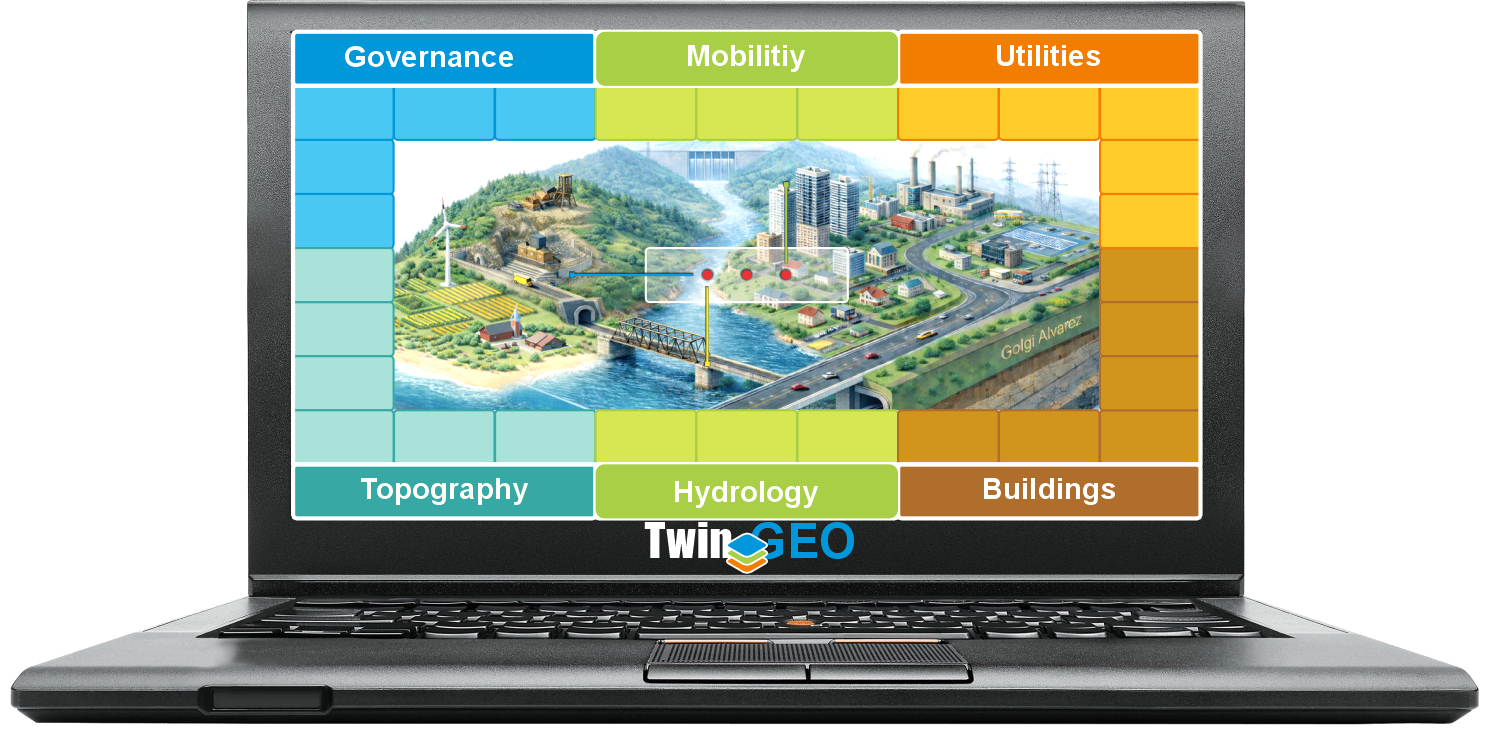
In the TwinGEO Framework, Domains represent the main functional perspectives through which territory is understood, governed, and transformed. Each domain reflects a real-world system with its own assets, processes, institutions, and decision logic.
Domains provide the contextual structure for Digital Twin development.
Domains Are Not Data Categories
TwinGEO domains are not:
- GIS layers
- BIM disciplines
- database schemas
- software modules
They are territorial system families that organize how assets are managed and how decisions are made in the real world.
This distinction ensures that Digital Twins remain aligned with institutional and societal reality.
Why Domains Matter in Digital Twins
Digital Twins often fail when domains are mixed or ignored:
- infrastructure modeled without legal context
- environmental systems disconnected from planning
- buildings isolated from mobility and utilities
By structuring Digital Twins around domains, TwinGEO ensures:
- clarity of scope
- coherence across disciplines
- meaningful integration across systems
Domains act as the entry points through which complexity is organized.
Core TwinGEO Domains
The TwinGEO Framework currently structures territory through the following domains:
- Governance – legal and administrative land systems
→ Explore Governance - Topography – physical form and terrain representation
→ Explore Topography - Hydrology – water systems and natural dynamics
→ Explore Hydrology - Mobility – movement networks and accessibility
→ Explore Mobility - Buildings – built environment and structures
→ Explore Buildings - Utilities – service networks and infrastructure systems
→ Explore Utilities
Each domain contributes distinct assets and processes while remaining interconnected with the others.
From Domains to Integrated Digital Twins
Domains do not operate in isolation.
A Digital Twin emerges when:
- assets are shared across domains
- processes cut across institutional boundaries
- observation integrates multiple perspectives
TwinGEO uses domains as a structuring mechanism, not as silos, enabling integration rather than fragmentation.
This integration logic is explained in detail within the TwinGEO Framework, where Domains, Assets, Layers, Processes, and Digital Twins are brought together.