



From Data Objects to Managed Territorial Assets
In many digital initiatives, territory is represented as data: layers, features, geometries, or records stored in a database.
While data is essential, data alone does not represent what is managed in the real world.
Territorial management revolves around assets: elements that have value, responsibility, lifecycle, and impact.
The TwinGEO Framework adopts an asset-based perspective, shifting the focus from abstract data models to tangible and accountable elements of the territory.
An asset is not defined by its geometry, but by its function, ownership, condition, and role within a system.
What Is an Asset in TwinGEO?
Within the TwinGEO Framework, an asset is:
- a physical, legal, or natural element of the territory
- identifiable and manageable over time
- subject to processes such as planning, operation, regulation, or maintenance
- relevant for decision-making
Assets exist at the intersection of reality, institutions, and digital representation.
This definition deliberately goes beyond purely physical infrastructure to reflect how territory is actually governed.
Types of Territorial Assets
TwinGEO recognizes different categories of assets, depending on their nature and role:
- Physical assets
Infrastructure networks, buildings, roads, bridges, hydraulic structures, and constructed elements. - Legal assets
Parcels, rights, easements, administrative units, concessions, and regulatory boundaries. - Natural assets
Rivers, watersheds, soils, ecosystems, forests, and environmental systems. - Functional assets
Service areas, operational zones, influence areas, and system components that exist through their function rather than form.
Together, these assets form the building blocks of territorial systems.
Assets and Territorial Domains
Assets do not exist in isolation.
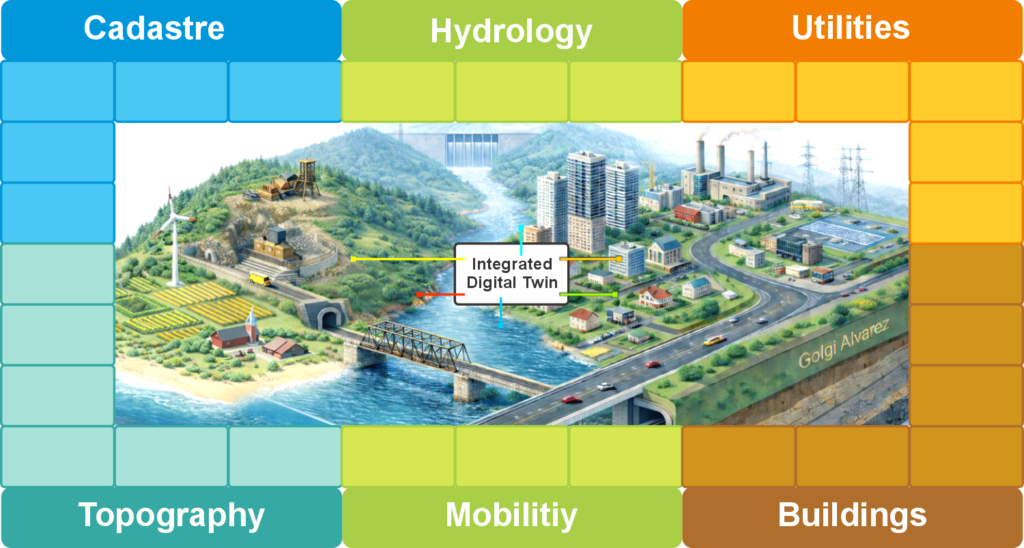
They are always framed within territorial domains, such as cadastre, mobility, utilities, hydrology, or buildings.
A single asset may belong to multiple domains simultaneously:
- a road segment is a mobility asset, a legal right-of-way, and an infrastructure element
- a river is a natural asset, a hydraulic system, and a regulatory boundary
TwinGEO allows assets to be understood across domains, avoiding rigid thematic silos.
Why an Asset-Based Approach Matters
Digital twins often fail when they are built around:
- disconnected datasets
- discipline-specific objects
- static representations
An asset-based approach ensures that digital models remain:
- aligned with institutional responsibility
- connected to lifecycle processes
- relevant for operational and strategic decisions
By focusing on assets, TwinGEO provides a stable anchor between data, processes, and reality.
Assets as the Foundation of Digital Twins
In the TwinGEO Framework:
- assets are what processes act upon
- assets are what observation validates
- assets are what digital twins ultimately represent
Understanding assets is the first step toward building digital twins that can evolve, integrate, and support decisions over time.
To understand how assets evolve, the next step is to explore Processes and Lifecycle within the framework.